How to Buy Bitcoin in 2026: Step-by-Step for Beginners

To buy bitcoin, open an account at a regulated exchange, verify your identity, deposit money by bank transfer or card, place a buy order for the amount of BTC you want, and then move the coins to a wallet you control. For most beginners the whole process takes under 30 minutes once the account is verified, and you can start with as little as a few dollars.
This guide walks through each step and the decisions that actually matter in 2026: where to buy, what it costs, how volatile the price is right now, and how to keep your bitcoin safe afterward.
Key takeaways
- You do not need to buy a whole bitcoin. Each BTC divides into 100 million units called satoshis, so any budget works.
- A bank transfer into a low-fee exchange is the cheapest route. Card purchases are faster but cost more.
- Bitcoin is volatile. It traded near $122,000 in late 2025 and around $63,000 by July 2026, according to CoinGecko.
- The biggest long-term risk is not the price, it is losing access. Move holdings you are not actively trading to a wallet you control.
How much does bitcoin cost right now?
Bitcoin is volatile, and the price you pay changes by the minute. Over the past year the price fell from about $111,000 in July 2025 to roughly $63,000 in July 2026, after touching a high near $122,000, based on CoinGecko market data. That swing is the single most important thing a first-time buyer should understand before funding an account.
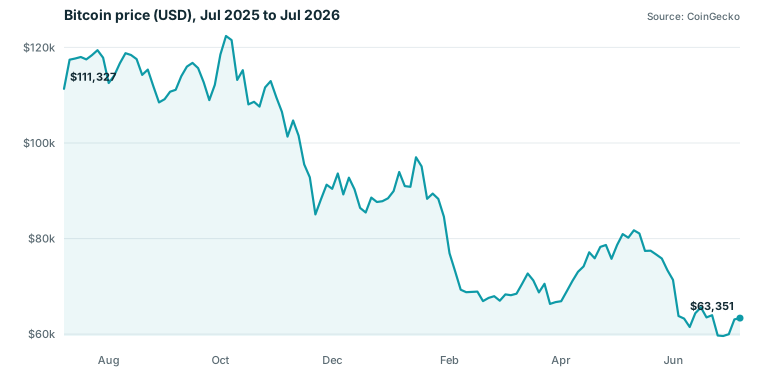
The practical takeaway: only commit money you can leave invested through drops like the one above, and treat your first purchase as a test run rather than your full budget.
Step 1: Choose an exchange
An exchange is where you swap regular money for bitcoin. For a first purchase, pick one that is available in your country, supports your local currency, and publishes a clear fee schedule. Two of the most common starting points are Coinbase, which is built for beginners, and Binance, which has the lower trading fees.
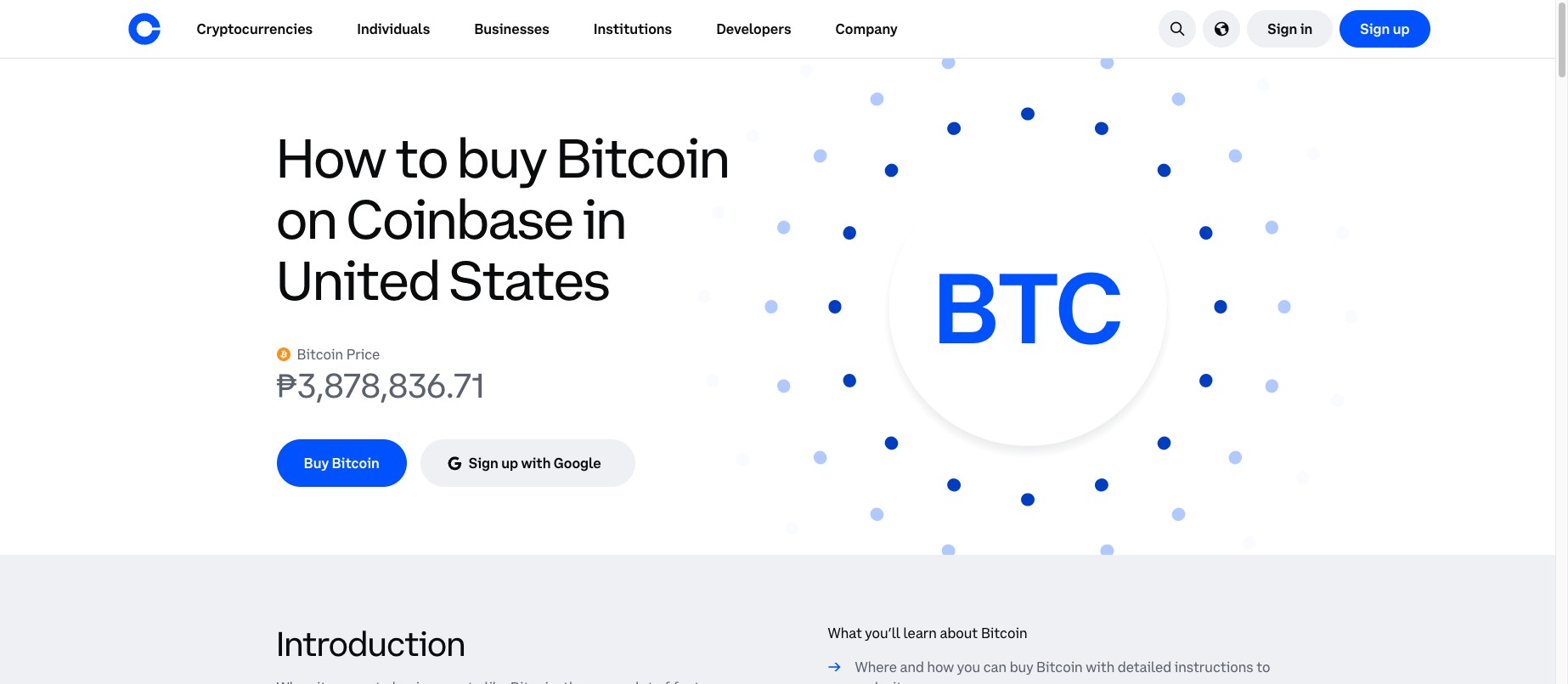
Fees are where beginners lose the most money without noticing. Binance’s published spot trading fee is 0.1 percent per trade, while beginner-friendly “instant buy” products on other platforms can cost well over 1 percent once the spread is included. What to compare:
| Factor | What to look for |
|---|---|
| Availability | Supports your country and local currency |
| Trading fee | Clear maker/taker rate, ideally under 1 percent |
| Payment methods | Bank transfer (cheapest) or card (fastest) |
| Security | Two-factor authentication, proof-of-reserves, clean track record |
Read our Binance review and Coinbase review for fee-by-fee detail, or compare them side by side in Binance vs Coinbase.
Step 2: Verify your account
Regulated exchanges require identity verification, usually called KYC (Know Your Customer). You upload a government ID and sometimes a selfie for comparison. Verification is approved within minutes to a few hours in most cases, though it can take longer during busy periods.
This step is not optional on a legitimate platform. Any service that lets you trade meaningful amounts with no verification at all is a red flag worth avoiding, because it signals the platform is ignoring the rules that protect you against fraud and account takeover.
Step 3: Fund your account
Fund with a bank transfer to pay the least, or a debit card to buy fastest. Bank transfers cost the least but can take one to three business days to clear, depending on your bank and country. Debit cards are close to instant but carry higher fees, since the exchange passes on card-processing costs.
Deposit only what you are comfortable investing. Given the price swings shown above, the safest first move is a small test deposit rather than your full budget on day one.
Step 4: Place your order
Choose a market order to buy instantly at the current price, or a limit order to set the exact price you are willing to pay and wait for the market to reach it. Market orders suit beginners because execution is simple and predictable.
You can buy a fraction of a bitcoin, so you do not need thousands of dollars to start. At a price near $63,000, $50 buys roughly 0.0008 BTC, or about 80,000 satoshis. Any budget can participate.
Step 5: Move bitcoin to your own wallet
Leaving large amounts on an exchange means trusting that exchange with custody of your coins, and exchange failures are one of the most common ways people lose crypto. The history is not hypothetical:
- Mt. Gox collapsed in 2014 after roughly 850,000 BTC went missing from what was then the largest bitcoin exchange.
- QuadrigaCX left customers unable to reach about C$190 million in 2019 after its founder died holding the only keys.
- FTX imploded in 2022, freezing customer withdrawals overnight.
The lesson those failures share is captured in a phrase you will see across crypto: not your keys, not your coins. Hardware wallet maker Ledger makes the same point from the security angle in its official account.
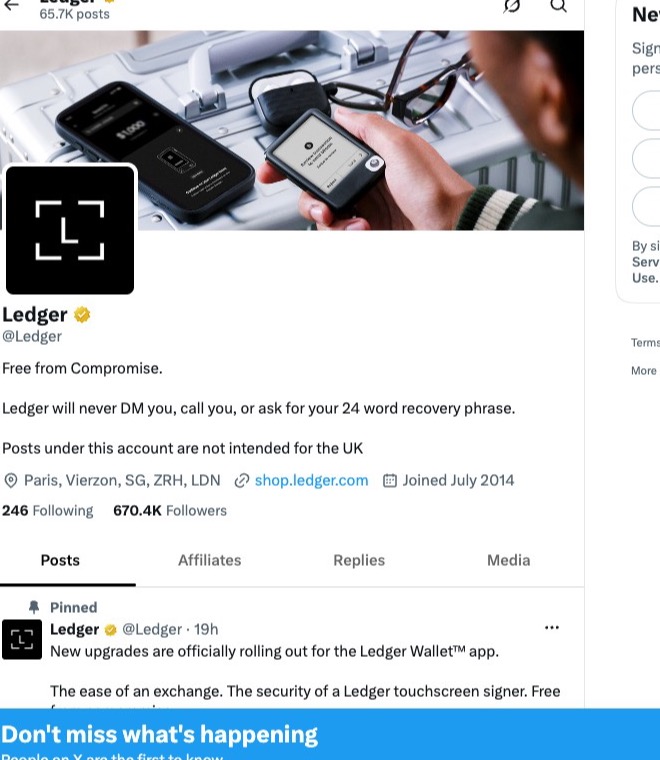
For anything you plan to hold rather than trade actively, transfer it to a wallet you control. Start with our guide to crypto wallets to understand the hot versus cold trade-off, and for the strongest protection on larger holdings see the Ledger wallet review.
Common mistakes to avoid
- Sending bitcoin to an address you have not double-checked. Transactions cannot be reversed once confirmed, so a single mistyped character can mean permanently lost funds.
- Leaving a large balance on the exchange indefinitely instead of moving it to your own wallet once you are done trading.
- Buying with a card and paying avoidable fees when a bank transfer would have worked just as well for a planned purchase.
- Ignoring two-factor authentication, which is one of the cheapest and most effective ways to protect an exchange account.
- Sharing your recovery phrase with anyone, including “support” staff. As Ledger’s warning above shows, that request is always a scam.
- Panic-selling during a price drop without a plan, rather than deciding your strategy in advance.
Frequently asked questions
How much money do I need to buy bitcoin? Most exchanges let you start with a few dollars, because bitcoin divides into 100 million units called satoshis. You do not need to buy a whole coin.
How long does it take to buy bitcoin? Once your account is verified, the purchase itself takes a minute or two. The slowest part is funding: card deposits are near-instant, while bank transfers can take one to three business days to clear.
What are the fees to buy bitcoin? It depends on the platform and payment method. Spot trading fees can be as low as 0.1 percent on exchanges like Binance, while beginner “instant buy” flows and card purchases often cost more than 1 percent once the spread is included.
Is buying bitcoin safe? Buying through a regulated exchange is reasonably safe. The bigger risk is losing access to your coins afterward, so use two-factor authentication and move long-term holdings to your own wallet.
Do I have to buy a whole bitcoin? No. You can buy any fraction, such as a small decimal amount of BTC, and most buyers never own a full coin.
Can I buy bitcoin without giving my identity? On regulated exchanges, no. Identity verification is required by law in most jurisdictions, and it is one of the signs you are using a legitimate platform rather than an unregulated one.
What should I do with bitcoin right after I buy it? Decide whether you plan to trade it soon or hold it long term. Active trading balances can stay on the exchange; long-term holdings are safer in a wallet you control, ideally a hardware wallet for larger amounts.
Next steps
Once you own bitcoin, learn how the network secures your coins in our blockchain guide. If you are curious about other coins, our broader how to buy crypto guide covers the same process for altcoins.
Last updated July 9, 2026. Price data from CoinGecko.