
What Is Bitcoin? The Original Cryptocurrency Explained

Bitcoin is the first cryptocurrency, launched in 2009, and remains the largest by market value at about $1.26 trillion in mid-2026. It is a decentralized digital money that lets people send value directly to each other over the internet without a bank, secured by a global network of computers rather than any single company or government. It was introduced by a pseudonymous developer or group using the name Satoshi Nakamoto, who published a white paper describing a peer-to-peer electronic cash system before the network went live.
Key takeaways
- Bitcoin is a decentralized digital money launched in 2009, secured by proof-of-work mining rather than any central authority.
- Its supply is capped at 21 million coins. About 20.05 million, or 95 percent, had been mined by mid-2026.
- It is the largest cryptocurrency, with a market value near $1.26 trillion and the number one market-cap rank.
- Bitcoin is volatile. It reached an all-time high of about $126,080 in October 2025 and traded near $63,000 by July 2026.
How does bitcoin work?
Bitcoin runs on a blockchain, a shared ledger maintained by thousands of computers worldwide, each holding a full copy of the transaction history. Transactions are confirmed through proof of work, where miners spend computing power competing to validate blocks and are rewarded with newly created bitcoin plus transaction fees. New blocks are added roughly every ten minutes, and each block links to the one before it using cryptographic hashes, so altering past transactions would require redoing the work for every block that came after.
You can watch this happen live. Public explorers like mempool.space show new blocks as miners find them, along with the pools that produced them and the current average block time:
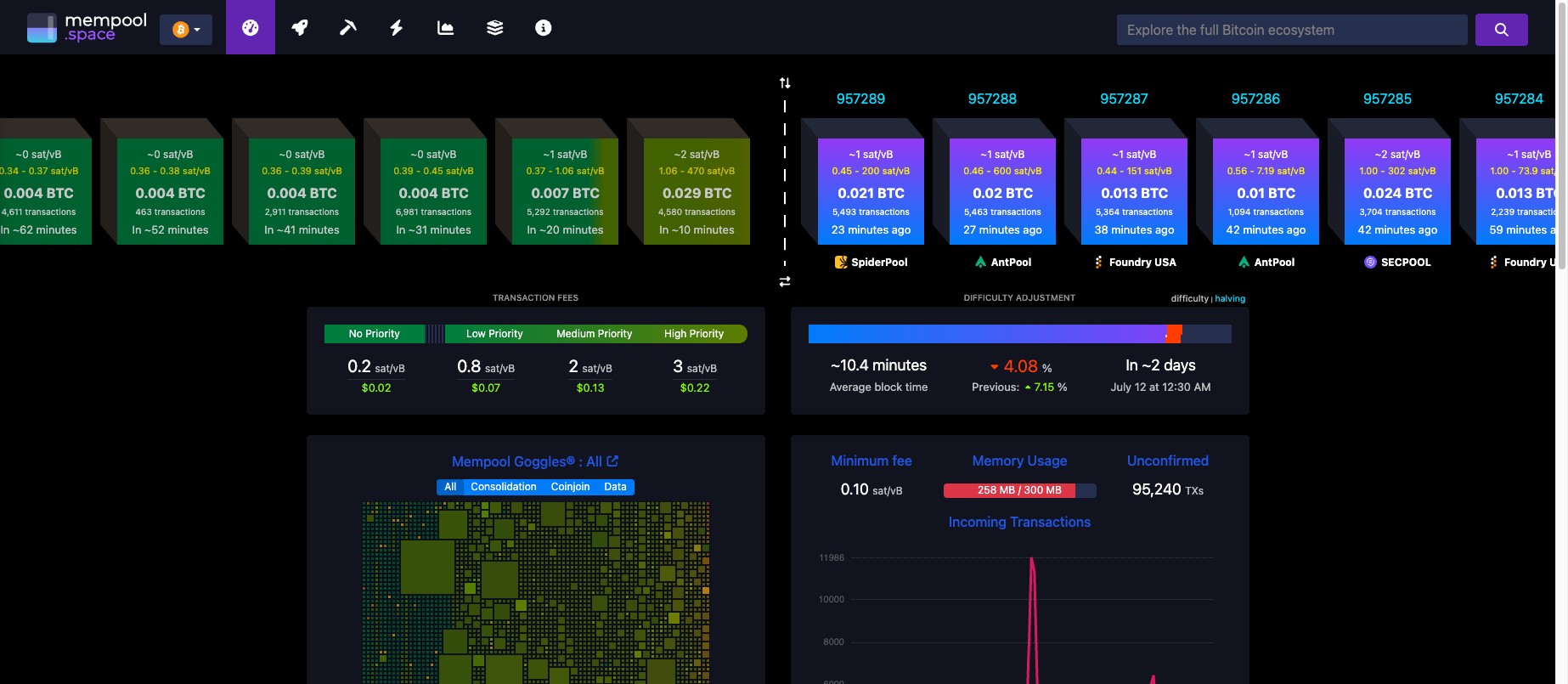
This design makes the record extremely costly to tamper with, and it is what lets bitcoin operate without a central authority. For the underlying mechanics, see our blockchain guide.
Key facts
| Property | Detail |
|---|---|
| Launched | 2009 |
| Creator | Satoshi Nakamoto (pseudonymous) |
| Market cap | About $1.26 trillion (rank 1), mid-2026 |
| Circulating supply | About 20.05 million BTC |
| Maximum supply | 21 million coins |
| Consensus | Proof of work |
| Average block time | About 10 minutes |
| Smallest unit | Satoshi (0.00000001 BTC) |
Why does the 21 million limit matter?
Bitcoin’s supply is capped at 21 million coins, and the rate of new issuance halves roughly every four years in an event called the halving. Miners originally received 50 new bitcoin per block, and that reward has stepped down repeatedly since. By mid-2026, about 20.05 million coins, or roughly 95 percent of the total, had already been mined.
Because the total supply is fixed and verifiable in the protocol’s open source code, nobody, including governments or the developers who maintain the software, can create more bitcoin on demand. This built-in scarcity is the main reason supporters describe bitcoin as digital gold. Critics counter that scarcity alone does not guarantee value, since price still depends on ongoing demand from buyers.
How volatile is bitcoin?
Bitcoin is highly volatile, and its price has historically moved through large swings in both directions. Over the year to July 2026 it fell from about $111,000 to roughly $63,000, after setting an all-time high near $126,080 in October 2025, according to CoinGecko. That is a drawdown of about 50 percent from the peak.
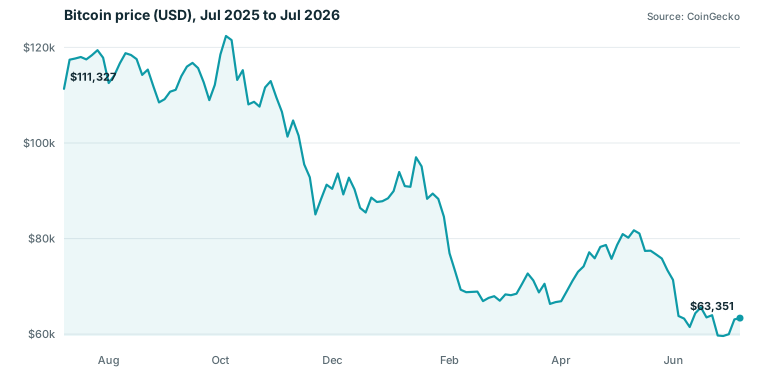
Swings like this are why the standard advice is to only invest what you can afford to lose, and to expect sharp drops as part of holding the asset.
Bitcoin compared with ethereum and solana
Bitcoin, ethereum, and solana are often mentioned together, but they solve different problems. Bitcoin is optimized for security and simplicity, with a scripting language that is deliberately limited so the network stays predictable and hard to attack. Ethereum and solana are programmable platforms built to run smart contracts and full applications, which makes them more flexible but also more complex under the hood. Bitcoin’s proof-of-work security model trades speed for a long track record of uninterrupted operation, while the newer proof-of-stake networks aim for faster confirmation at the cost of a shorter history. For many investors, bitcoin functions as the reserve asset of the crypto market, with other coins often priced and tracked in relation to it.
What is bitcoin used for?
- A long-term store of value held by individuals, companies, and increasingly institutions.
- Payments and transfers that settle without a bank or intermediary, useful for cross-border transfers.
- A reserve asset that other crypto markets are priced against.
- Exposure through regulated products, such as the spot bitcoin ETFs that brought bitcoin into ordinary brokerage accounts; our bitcoin ETF explainer covers how those work.
Risks to understand
Bitcoin’s price can fall hard and fast, as the chart above shows, and there is no guarantee it will hold or increase in value over any given period. Regulation is another factor worth watching, since rules around trading, taxation, and custody continue to develop across different countries; our crypto regulation overview tracks the current landscape. Losing access to a wallet’s private keys means losing the bitcoin permanently, since no central authority can reverse a lost password or a mistaken transfer. Scams and phishing attempts targeting bitcoin holders are also common, so verifying sources and using secure storage matters as much as the investment decision itself.
How to own bitcoin
You can buy bitcoin on an exchange and hold a fraction of a coin, since bitcoin is divisible down to the satoshi. Follow our step-by-step how to buy bitcoin guide to compare exchange options, including those covered in our Binance vs Coinbase comparison, then move it to a wallet you control using our crypto wallets guide. For long-term holdings, many owners prefer a hardware wallet, such as the ones covered in our Ledger review, which keeps private keys offline and away from exchange hacks.
Frequently asked questions
Is bitcoin a good investment? Bitcoin is volatile and not guaranteed to rise. It fell about 50 percent from its October 2025 high within months. Many treat it as a long-term, high-risk holding rather than a sure bet, and only invest what they can afford to lose.
How many bitcoins are left? About 20.05 million of the 21 million cap had been mined by mid-2026, leaving under 1 million to be issued. The final coins are expected to be mined around the year 2140 due to halvings.
Can bitcoin be shut down? Because it runs across a decentralized global network, there is no single point to shut down, which is a core part of its design.
Who created bitcoin? Bitcoin was created by a person or group using the pseudonym Satoshi Nakamoto, whose real identity has never been confirmed. Nakamoto stopped participating publicly a few years after launch, leaving development to an open community of contributors.
Is bitcoin the same thing as blockchain? No. Blockchain is the underlying technology, a shared ledger structure that records data in linked blocks. Bitcoin is one application of that technology, specifically a currency network.
What is the difference between bitcoin and ethereum? Bitcoin focuses on being sound, scarce digital money, while ethereum is a broader platform for building applications on top of a blockchain. Both share some technical roots but aim at different goals.
Related reading
Learn more about who researches and writes our coverage on the about page, and see our editorial policy for how we verify claims before publishing.
Last updated July 9, 2026. Price and supply data from CoinGecko; network data from mempool.space.