
Coinbase vs Kraken: Which US Exchange Should You Pick?

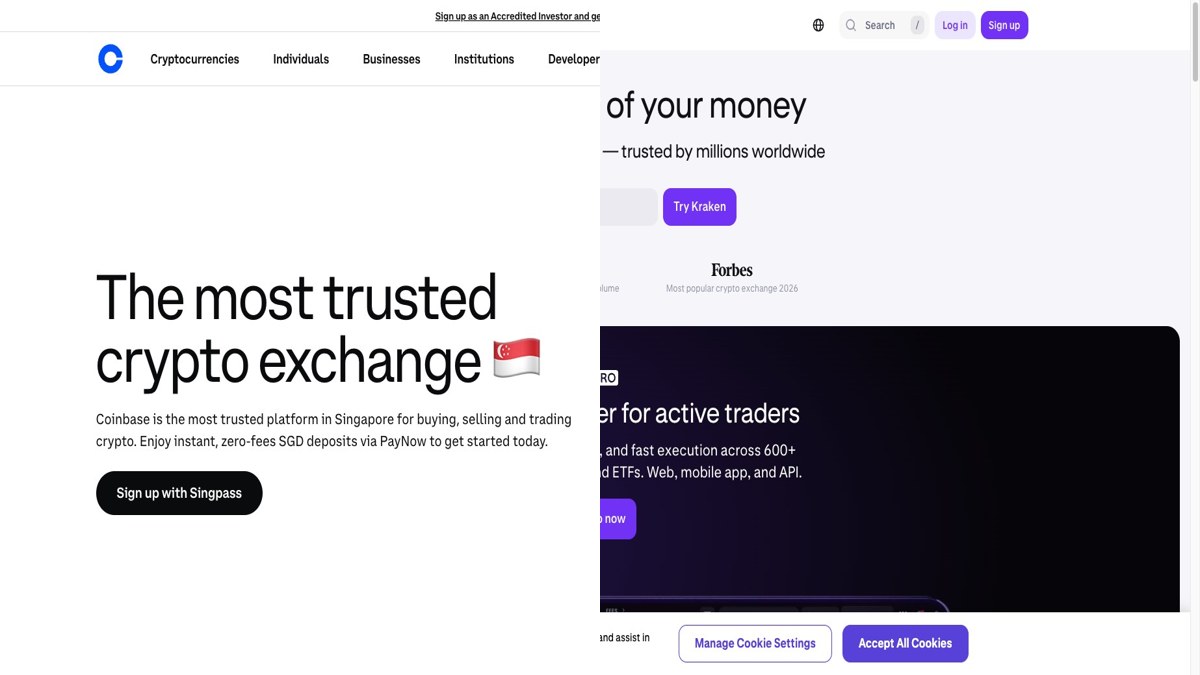
The short answer: choose Coinbase if you want the smoothest possible first purchase, and choose Kraken if you care more about security pedigree and keeping trading costs down. These are the two mainstream US-compliant exchange choices, so you are not trading regulatory comfort for features either way. Both are American companies with well over a decade of history, and both are safe defaults. The differences show up in interface design, fee structure, and philosophy, and this guide walks through each so you can pick the one that fits how you actually plan to use it.
Head-to-head comparison
| Factor | Coinbase | Kraken |
|---|---|---|
| Founded | 2012, NASDAQ-listed public company | 2011, private company |
| Ease of use | Excellent, built for first-timers | Good, with a separate Pro interface |
| Standard fees | High on the simple interface | High on the simple interface |
| Cheap path | Coinbase Advanced | Kraken Pro |
| Security record | Public-company audits, custody arm | Never hacked, proof of reserves |
| Coin selection | Broad, curated toward majors | Broad, similar coverage of majors |
| Best for | Beginners and set-and-forget buyers | Cost-conscious and security-focused users |
Track record and trust
Both exchanges are crypto old-timers. Kraken launched in 2011, Coinbase in 2012, which means each has survived multiple full market cycles, exchange collapses, and regulatory waves that wiped out many competitors. Coinbase went public on the NASDAQ in 2021, making it the most scrutinized crypto company in America: quarterly earnings, audited financials, and public-company disclosure obligations. Kraken has stayed private but holds one of the most valuable reputations in the industry, a security record with no successful hack of its core exchange in its entire history. You can go deeper on each platform in our full Coinbase review and Kraken review.
Ease of use
Coinbase wins this one, and it is not close. Its onboarding is the smoothest in the industry, which is why it is so often the first exchange Americans use when they buy crypto for the first time. The app walks you from signup to a completed purchase with almost no friction, and the design assumes zero prior knowledge.
Kraken splits its experience in two. The standard Kraken app is simple enough for a beginner, though a notch less polished than Coinbase. Kraken Pro is a separate, denser interface aimed at active traders, with order books, charting, and advanced order types. That split works well once you know which side of it you belong on, but a total newcomer will find Coinbase’s single guided path easier.
Fees
Here is the part both companies would rather you skim past: the simple, convenient interface on each platform is the expensive way to buy. Coinbase’s standard buy flow and Kraken’s instant-buy option both carry a hefty convenience premium, and casual users routinely overpay without realizing a cheaper route exists on the same account.
That cheaper route is Coinbase Advanced on one side and Kraken Pro on the other. Both are free to access, both use maker and taker pricing that is dramatically lower than the simple interface, and both reward higher volume with better rates. Historically, Kraken Pro’s fee schedule has tended to undercut Coinbase Advanced for typical retail volumes, which is part of why cost-conscious traders gravitate to Kraken. Exact percentages shift over time, so check each platform’s current fee page before committing, but the principle is stable: on either exchange, learn the advanced interface and your costs drop sharply.
Coins and features
For the assets most people actually buy, the two are nearly interchangeable. Bitcoin, Ethereum, Solana, XRP, Cardano, and Dogecoin are all available on both. Differences appear at the margins: each lists some smaller altcoins the other does not, and listing decisions can also differ state by state. If one specific mid-cap token is the reason you are opening an account, check both platforms’ current listings for your state first.
Both offer staking on eligible proof-of-stake coins, a concept covered in our crypto staking guide. Notably, both companies have faced pressure from US regulators over their staking products, and each has had to adjust what it offers American customers as a result. The broader squeeze on US exchanges is covered in our crypto regulation overview. The practical takeaway: staking availability on either platform can change with the regulatory weather, so treat it as a bonus rather than a deciding factor.
Security and transparency
This is Kraken’s strongest card. The exchange has never suffered a successful hack of its core platform since 2011, an almost unmatched record in an industry where breaches were once routine. Kraken also publishes proof of reserves, cryptographic evidence that customer assets are actually held, which it pioneered earlier than most large exchanges.
Coinbase answers with a different kind of assurance: public-company accountability. Its financials are audited, its custody practices run through a dedicated regulated custody arm, and misstating what it holds would be securities fraud. Neither approach is strictly better; Kraken proves its reserves cryptographically, Coinbase proves its solvency through the traditional audit system. Either way, the standard advice applies: keep long-term holdings in your own wallet rather than on any exchange, as explained in our crypto wallets guide.
Who should choose which
Choose Coinbase if:
- You are making your first crypto purchase and want the gentlest on-ramp
- Public-company oversight and audited financials give you peace of mind
- You mostly buy and hold majors and value polish over the last bit of fee savings
Choose Kraken if:
- You want the stronger raw security record and proof of reserves
- You plan to trade with any regularity and want Kraken Pro’s lower costs
- You have outgrown beginner apps and are comfortable with a denser interface
Plenty of people run both: Coinbase for quick, easy purchases and Kraken Pro for larger or more frequent trades. There is no penalty for holding two accounts, and it takes the pressure off getting the choice exactly right on day one. If you are also weighing an international platform against these two, our Binance vs Coinbase comparison covers that trade-off.
The bottom line
- Pick Coinbase for the easiest, most beginner-friendly US exchange experience.
- Pick Kraken for stronger security credentials and cheaper trading via Kraken Pro.
Frequently asked questions
Is Kraken cheaper than Coinbase? On the advanced interfaces, Kraken Pro has generally offered lower rates than Coinbase Advanced at typical retail volumes. Both simple interfaces are expensive; avoid them for anything beyond small casual buys.
Is Kraken safe to use? Yes. Kraken has operated since 2011 without a successful hack of its core exchange and publishes proof of reserves. It is widely regarded as one of the most secure exchanges available.
Which is better for beginners, Coinbase or Kraken? Coinbase. Its signup and purchase flow is the simplest in the US market. Kraken is friendly enough, but Coinbase is purpose-built for first-time buyers.
Can I use both Coinbase and Kraken? Yes. Many users keep both accounts and route each purchase to whichever platform is cheaper or more convenient for that trade.
Do Coinbase and Kraken both offer staking? Both offer staking on eligible coins for US customers, though regulatory pressure has forced changes to both programs over time. Check current availability for your state before counting on it.
Which has more coins, Coinbase or Kraken? They are similar for major assets. Each lists some smaller tokens the other lacks, so if a specific altcoin matters to you, check both listings directly.
Related reading
- How to buy bitcoin, for a step-by-step first purchase walkthrough
- Ledger review, for moving long-term holdings into self-custody
- Binance review, if you are also considering the largest global exchange