Kraken Review: Fees, Security, and Is It Right for You?

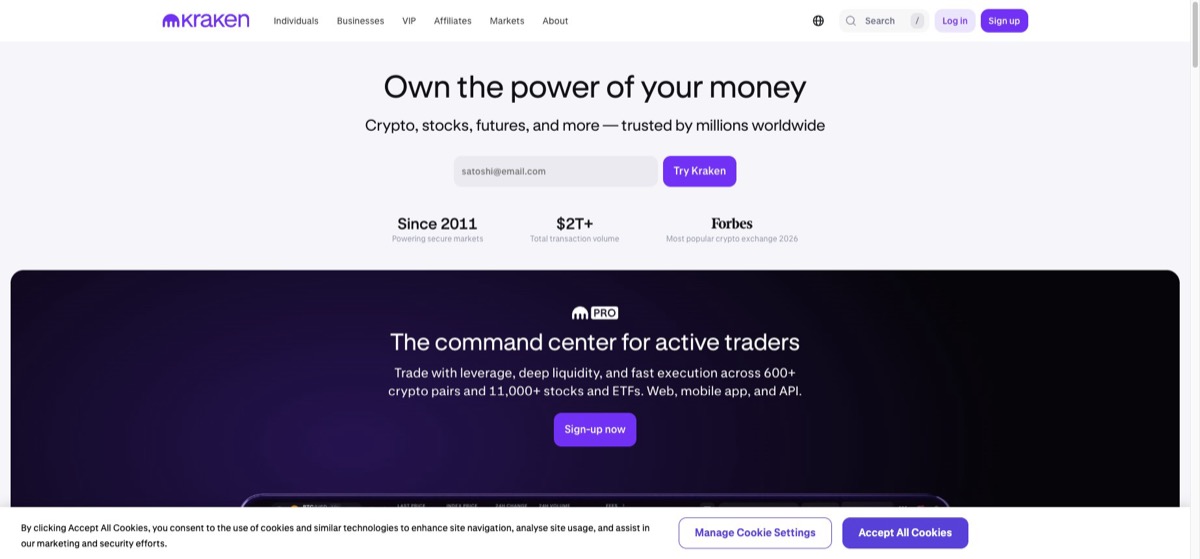
Kraken is one of the oldest cryptocurrency exchanges still operating, and its defining strength is a security track record that almost no major competitor can match: it has never suffered a major hack. The trade-off is a platform split between a simple interface with high convenience fees and a Pro interface that is much cheaper but less friendly, plus a coin selection that trails the biggest global exchanges. This review covers where Kraken came from, what it costs, how safe it is, and who should actually use it.
Verdict at a glance
Kraken is best for security-conscious users and intermediate traders who are willing to use the Pro interface to get competitive fees. Beginners can use it too, but they should learn the difference between the simple and Pro sides of the platform early, because it changes what they pay.
| Category | Rating |
|---|---|
| Security | Excellent |
| Fees (Kraken Pro) | Strong |
| Fees (simple interface) | Weak |
| Coin selection | Good |
| Ease of use | Moderate |
History and reputation
Kraken was founded in 2011 by Jesse Powell and is based in San Francisco, which makes it one of the longest-running exchanges in the industry. It launched in the aftermath of the early Mt. Gox era, and Powell built it explicitly around not repeating those failures. That longevity matters in a market where exchanges regularly appear, collapse, and disappear with customer funds. Kraken has operated through every major crypto cycle since bitcoin was trading for pocket change, and surviving that long without a catastrophic incident is itself a form of evidence about how the company is run.
Security
Security is the headline reason to choose Kraken. The exchange has never been the victim of a major hack, a claim very few platforms of its age and size can make. It keeps the large majority of customer funds in cold storage, runs an internal security team that also researches vulnerabilities in other products, and offers the standard account protections you should turn on immediately: two-factor authentication, withdrawal address whitelisting, and a global settings lock.
Kraken also publishes proof-of-reserves audits, in which an independent party verifies that the exchange actually holds the customer assets it claims to hold. Not every large exchange does this, and it became a much bigger deal after the exchange collapses of past cycles. The usual caveat still applies: any coins on an exchange are custodial, so long-term holdings belong in your own wallet. Our crypto wallets guide explains the options, and the Ledger review covers a popular hardware choice.
Fees
Kraken’s fee structure has two very different faces. Kraken Pro, the full trading interface, uses a maker/taker model with tiers that get cheaper as your monthly volume grows. Rates on Pro are competitive with other major exchanges, and active traders will find them reasonable. The simple buy interface and the instant-buy options are a different story: convenience purchases, especially by card, carry markups that are high in the way most exchanges’ instant-buy products are high. The fix is straightforward. Fund your account by bank transfer where possible and place orders through Kraken Pro rather than the one-click buy screen. The same logic applies almost everywhere, as we explain in our guide to how to buy crypto: the easiest button on any exchange is nearly always the most expensive one.
Supported coins and staking
Kraken lists a broad range of assets, including all the majors like ethereum and solana alongside a solid mid-cap selection. It is noticeably more conservative about listings than Binance, so if your strategy revolves around very small or very new altcoins, you will find gaps here. For most investors that conservatism is a feature rather than a bug, since Kraken vets what it lists.
Staking is one of Kraken’s stronger products. Eligible proof-of-stake assets can be staked directly from your account, with rewards paid out on a regular schedule and terms that vary by asset. Availability depends on where you live, and some staking products are restricted for US users because of regulatory constraints. If staking is new to you, our crypto staking guide covers how the mechanics and risks work before you commit funds.
Regulation and availability
Kraken is a US-based, US-regulated exchange, which cuts both ways. On one hand, it operates under real oversight and has a long history of cooperating with regulators rather than relocating to avoid them. On the other, that posture means some products, including certain staking services and derivatives, are limited or unavailable for US customers. The rules keep shifting as governments work out how to treat crypto platforms, a process we track in our crypto regulation overview. If a specific product matters to you, check what is available in your country before funding an account.
Who it is for
Choose Kraken if security is your top priority and you want an exchange with more than a decade of clean operating history. It suits intermediate traders comfortable with the Pro interface, long-term holders who want a trustworthy on-ramp, and anyone who values proof-of-reserves transparency. If you want the absolute simplest first purchase, Coinbase has a smoother beginner flow, and if you want the deepest altcoin selection, larger offshore platforms list more. Kraken sits in the sensible middle: safer than most, cheaper than the beginner-focused platforms once you use Pro, and honest about what it offers.
Pros and cons
Pros
- No major hack since its 2011 founding, an almost unique record among large exchanges
- Proof-of-reserves audits verify customer funds are actually held
- Competitive maker/taker fees on Kraken Pro that fall with volume
- Solid staking products for eligible proof-of-stake assets
- Long, cooperative regulatory history as a US-based exchange
Cons
- The split between the simple interface and Kraken Pro confuses beginners, and the simple side charges much more
- Instant-buy and card purchase fees are high, as on most exchanges
- Fewer altcoins than Binance and other listing-heavy competitors
- Some products, including certain staking services, are restricted for US users
Frequently asked questions
Is Kraken safe? Kraken has never suffered a major hack, keeps most funds in cold storage, and publishes proof-of-reserves audits. No exchange is risk-free, so still enable two-factor authentication and self-custody long-term holdings.
Who founded Kraken? Jesse Powell founded Kraken in 2011 in San Francisco, making it one of the oldest cryptocurrency exchanges still in operation.
Is Kraken good for beginners? It works for beginners, but the split between the simple interface and Kraken Pro is confusing at first. Learning to use Pro early saves meaningful money on fees.
What are Kraken’s fees? Kraken Pro uses a tiered maker/taker model that gets cheaper with volume and is competitive with other major exchanges. The simple interface and instant-buy options cost considerably more, so avoid them for anything beyond trivial amounts.
Can I stake crypto on Kraken? Yes, for eligible proof-of-stake assets, with rewards and terms varying by coin. Some staking products are restricted for US customers, so check availability in your region.
How does Kraken compare to Binance? Binance wins on coin selection and headline fees, while Kraken wins decisively on security record and proof-of-reserves transparency. Cautious investors tend to prefer Kraken; altcoin hunters lean toward Binance.
Related reading
- How to buy bitcoin, for a step-by-step first purchase walkthrough
- What is blockchain, for a primer on the technology behind the coins you are trading
- Bitcoin ETF explained, for context on how institutional products changed the market Kraken operates in