
KuCoin Review: Altcoin Selection, Fees, and Safety

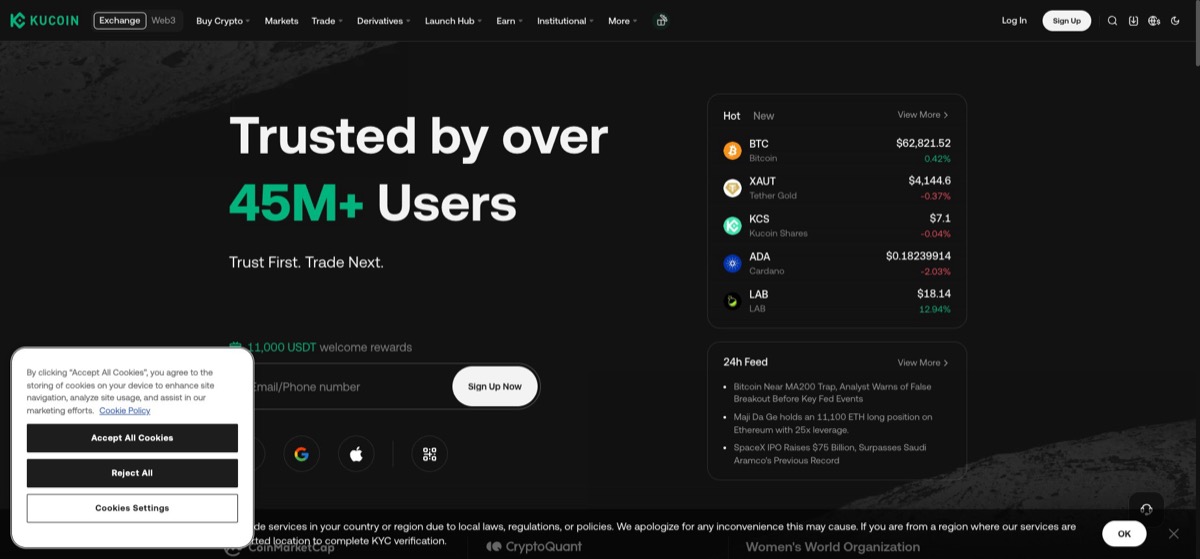
KuCoin, launched in 2017 and based in the Seychelles, has earned the nickname “the people’s exchange” for one reason above all: it lists more altcoins than almost anyone else, and it often lists them earlier. If you hunt for small-cap tokens before they reach the major platforms, KuCoin is probably already on your radar. The trade-offs are real, though. It sits in a regulatory gray area, it is off-limits to US users, and its deep feature set can swallow a beginner whole. This review covers the fees, the token selection, the security record, and who should actually use it.
Verdict at a glance
KuCoin is best for experienced, non-US users who want early access to small-cap altcoins at low trading costs. It is a weaker fit for beginners, for anyone in the United States, and for people who want smooth bank-card fiat purchases as their main way in.
| Category | Rating |
|---|---|
| Fees | Excellent |
| Coin selection | Excellent |
| Ease of use | Moderate |
| Security | Good |
| Beginner friendliness | Low |
| Fiat on-ramps | Limited |
Fees and the KCS token
KuCoin runs a maker/taker fee model with low headline rates that sit toward the cheap end of the industry, and costs fall further as your trading volume climbs. The platform also has its own native token, KuCoin Token (KCS), and holding or paying fees in it earns you a discount on trading costs. If that sounds familiar, it is the same playbook we describe in our Binance review, where BNB plays the equivalent role. KCS goes a step further than a simple fee coupon: holders receive a daily share of the platform’s trading fee revenue, which gives the token a dividend-like character that most exchange tokens lack. Exact rates and tier thresholds change over time, so check the current fee schedule before committing to a strategy that depends on them.
Altcoin selection and trading features
Coin selection is where KuCoin separates itself from the pack. The exchange lists hundreds of assets, and it has a long track record of adding small-cap and newly launched tokens well before the larger, more conservative platforms touch them. You will find bitcoin, ethereum, and solana here like everywhere else, but the real draw is the long tail of projects you simply cannot buy on a beginner-focused exchange. That early-listing culture cuts both ways: getting in first means holding tokens no listing committee has vetted, so the research burden falls squarely on you.
The feature set is just as broad. Beyond spot trading, KuCoin offers futures, margin trading, built-in trading bots that automate strategies like grid trading and dollar-cost averaging, and a lending market where you can earn yield on idle assets. The bots deserve a mention because few exchanges bundle them for free at this level. For holders of proof-of-stake coins there are also earn products in the same family as what we cover in our staking guide. It adds up to a powerful toolkit, and to a busy interface that takes time to learn.
Security and the 2020 hack
KuCoin’s security history includes the event most reviews tiptoe around, so let us be direct. In 2020 the exchange suffered a significant hack in which attackers drained funds from its hot wallets. What matters most is what happened next: KuCoin recovered a large portion of the stolen assets by working with other exchanges and token projects, and covered the remainder through its insurance fund and treasury. Users were made whole. That episode was a genuine stress test, and the exchange passed it.
Day to day, KuCoin offers the standard protections you should expect: two-factor authentication, a separate trading password, withdrawal address whitelisting, and cold storage for the bulk of customer funds. The usual rule still applies here as on every exchange. Balances you plan to hold long term belong in your own wallet, not on a trading platform, and our crypto wallets guide explains how to set that up. A hardware device like the one in our Ledger review is the strongest version of that move.
Regulation and availability
This is KuCoin’s weakest flank. The exchange is not licensed in the United States, and US users are restricted from the platform, a line that has been enforced with increasing seriousness in recent years. KuCoin also now requires identity verification for its services, so the old reputation as a no-KYC venue no longer reflects reality. Its Seychelles base keeps it outside the strictest regulatory regimes, which is precisely what lets it list tokens so freely, but it also means fewer formal protections than a fully licensed platform offers. Fiat on-ramps are another soft spot: card purchases and bank transfers run through third-party providers, and the experience is thinner than what a fiat-first exchange like the one in our Coinbase review delivers. Governments tightening rules on offshore exchanges, a trend we track in our crypto regulation overview, is the main long-term risk to weigh before making KuCoin your primary venue.
Who it is for
Choose KuCoin if you live outside the United States, you already know your way around an exchange, and early access to small-cap altcoins is a core part of your strategy. The low fees, KCS perks, and bundled trading bots reward active users who will actually exploit them. Skip it if you are making your first crypto purchase, if you are a US resident, or if you want a heavily regulated platform with polished fiat rails. In those cases a simpler, licensed exchange is the better starting point, even at a higher cost per trade.
Pros and cons
Pros
- One of the largest altcoin selections anywhere, with a habit of listing small caps early
- Low maker/taker fees that drop further with volume or KCS discounts
- KCS holders earn a daily share of platform trading fee revenue
- Broad toolkit: spot, futures, margin, lending, and free built-in trading bots
- Passed a real-world security test by fully reimbursing users after the 2020 hack
Cons
- Not licensed in the US, and US users are restricted
- Operates in a regulatory gray area with fewer formal user protections
- The 2020 hack remains a blemish on the record, however well it was handled
- Feature depth and interface density overwhelm beginners
- Fiat on-ramps are thin compared with fiat-first exchanges
Frequently asked questions
Is KuCoin safe? KuCoin offers standard protections like two-factor authentication and cold storage, and it fully reimbursed users after its 2020 hack. No exchange is risk-free, so keep long-term holdings in your own wallet.
Can US users trade on KuCoin? No. KuCoin is not licensed in the United States and US users are restricted from the platform. US residents should choose a licensed domestic exchange instead.
What is KCS used for? KuCoin Token (KCS) gives holders a discount on trading fees and a daily share of the platform’s trading fee revenue. Its benefits scale with how much you hold and trade.
Does KuCoin require KYC? Yes. KuCoin now requires identity verification, so the platform’s old no-KYC reputation is out of date.
Why do people call KuCoin the people’s exchange? The nickname comes from its huge altcoin selection and its habit of listing small community-driven tokens long before major exchanges do.
Is KuCoin good for beginners? Not really. The interface is dense and the feature set is deep. Beginners are usually better served starting on a simpler platform and coming to KuCoin later for altcoin access.
Related reading
- How to buy crypto, for a walkthrough of payment methods and first purchases
- Binance vs Coinbase, for how the two biggest mainstream alternatives compare
- Kraken review, for a security-focused exchange with a cleaner regulatory standing